Most beginner programmes fail for the same reason: they are designed to look serious. Five days a week, twelve exercises, a warm-up routine longer than the session itself. Week three arrives, life happens, and the whole thing collapses.
Here is the version built for a real calendar.
The frame: two sessions, six patterns
Almost everything worth training fits into six movement patterns. Cover them twice a week and you have a complete programme.
| Pattern | Example | Sets × reps |
|---|---|---|
| Squat | Goblet squat | 3 × 8 |
| Hinge | Romanian deadlift | 3 × 8 |
| Push | Push-up or dumbbell press | 3 × 8 |
| Pull | Row with dumbbell or band | 3 × 10 |
| Carry | Farmer's walk, 30 seconds | 3 rounds |
| Core | Dead bug or plank | 3 × 30 s |
That is the entire session — roughly 35–45 minutes including rest. Do it twice a week on non-consecutive days for twelve weeks.
Rest is part of the set
Take 90 seconds between sets. Rushing turns a strength session into a mediocre cardio session and blunts the point of doing it.
The one progression rule
Add the smallest available weight increment when you complete all prescribed reps with good form and still feel two reps in reserve on the last set. Not before.
This sounds conservative. Over twelve weeks it compounds: a 2 kg increase every two weeks on a lift starting at 20 kg is a 60% increase by the end. Most people who stall have been adding weight faster than their technique.
Soreness, form and the first month
Muscle soreness two days after a new session is normal and fades as your body adapts; it is not a measure of a good workout. Sharp pain during a movement is different — stop, reduce the weight and check the pattern.
The first month is mostly neurological. Strength rises quickly because your nervous system gets better at recruiting muscle, before visible size changes appear. This is why week four often feels great and week eight feels slow: nothing is wrong, the easy adaptations are simply used up.

Kiva's advice
Missing a session is not failure; missing two in a row is how programmes end. If the week collapses, do one 20-minute session and call it a win.
What to eat around it
Nothing exotic. Enough total protein across the day, a normal meal within a few hours either side of training, and enough total calories to recover. Supplements are optional and none of them replace consistency.
What to track
- Weight and reps per set — the only way to know you are progressing.
- How the session felt — one word is enough; patterns emerge fast.
- Body measurements monthly — the scale alone hides muscle gain.
After twelve weeks you will have a record showing exactly what you can lift and how you got there. That record, not the first month's enthusiasm, is what makes month six possible.
Frequently asked questions
How many times a week should a beginner train?
Two full-body sessions a week is enough to build strength in the first months, and it is far easier to sustain than four. Three works well once two has become automatic.
Do I need a gym to start?
No. Bodyweight squats, push-ups on an incline, rows with a band, hip hinges and carries build a real foundation. A gym mainly makes it easier to add weight gradually later.
How do I know when to add weight?
When you can complete every prescribed rep with good form and the last rep still feels like you had two more in reserve, add the smallest available increment next session.
Keep reading
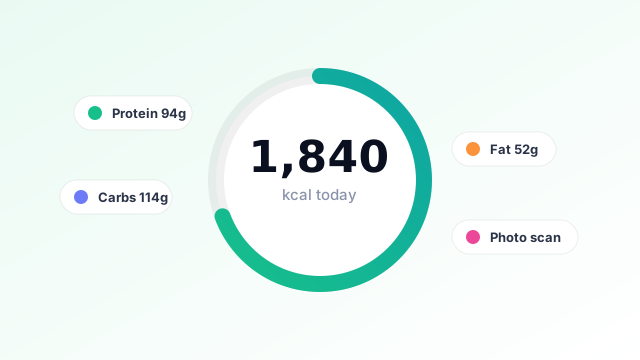
How much protein do you actually need?
Grams per kilo, not percentages — and why how you spread protein across the day matters more than the exact daily total.
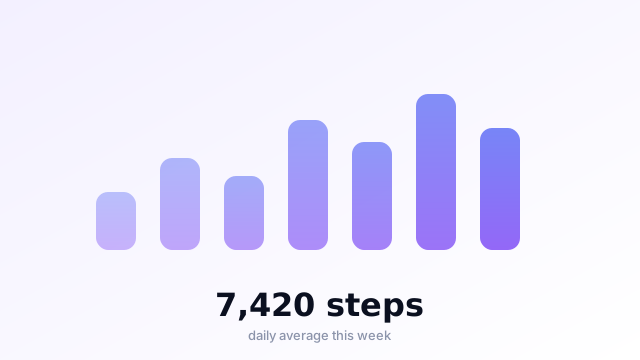
Is 10,000 steps a day a real target?
The number came from a 1960s pedometer name. What the research since then says about how many steps actually matter.
Read how we select sources, prepare bilingual content, verify calculations and handle corrections in our editorial policy. Professional medical review is present only when explicitly stated.