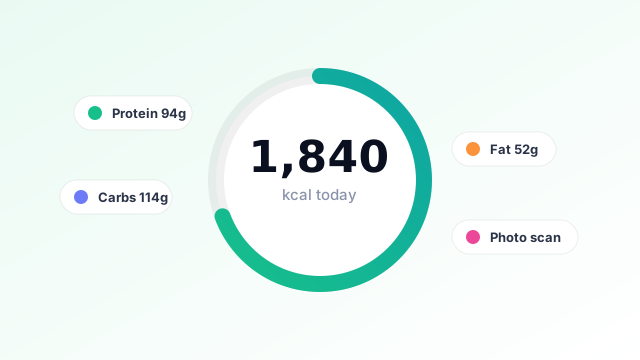
If you have ever logged food carefully for a week and seen the scale refuse to move, you have met the gap between what a food log says and what actually went into your body. Research on self-reported intake keeps finding the same thing: people under-report by roughly a fifth to a third, and they do it sincerely. The fix is not more willpower. It is closing five specific gaps.
Why food logs drift
Under-reporting is rarely one big lie. It is a hundred small omissions that share a pattern: the things easiest to forget are the things densest in calories.
- Cooking fat. A tablespoon of olive oil in the pan is around 120 kcal. Two pans a day is a croissant you never counted.
- Bites and tastes. The corner of a child's toast, three chips from someone else's plate, the spoonful while cooking.
- Liquid calories. Lattes, juice, cola, alcohol. They leave no plate behind, so they leave no memory behind.
- Weekend blindness. Many logs are meticulous Monday to Friday and blank on Saturday — which is exactly when intake is highest.
- Optimistic portions. "One serving" of pasta on a box is usually far less than what lands on a plate.
The five habits that fix it
1. Weigh for two weeks, then estimate
A kitchen scale is not a life sentence. Use it for fourteen days and it recalibrates your eye permanently: you learn what 100 g of rice, 30 g of cheese and 15 g of peanut butter actually look like. After that, weigh only the calorie-dense offenders — oils, nuts, nut butters, cheese, granola — and estimate the rest.
2. Log before you eat, not after
Logging afterwards turns your food diary into a memory test you will fail. Logging first turns it into a decision: you see the number while you can still change it. This single switch does more for accuracy than any database.
3. Count the cooking fat separately
Add the oil, butter or ghee as its own line item, not as part of "chicken with vegetables". If you share a pan-cooked meal, log half of what went into the pan.
4. Give liquids their own ritual
Log drinks the moment you order them. Coffee shop drinks are the largest single blind spot in most logs — a large flavoured latte can carry more calories than a bowl of pasta.
5. Log the bad days hardest
The days you least want to log are the days that contain the most information. A log with a hole in it does not show a smaller week; it shows a fictional one. Log the whole thing, no commentary, and move on.

Kiva's rule of thumb
If logging a meal takes longer than eating it, you will quit within two weeks. Speed beats precision — a rough entry today is worth more than a perfect entry you never make.
Setting a target you can actually hit
Most calculators start from an estimate of your resting metabolism and multiply it by an activity factor. That estimate can be off by a few hundred calories in either direction for any individual, which is why the number a calculator gives you is a starting hypothesis, not a prescription.
Use it like this: eat at that number for two to three weeks while logging honestly, track your weight trend rather than daily readings, and adjust based on what actually happened. Your own data beats any formula after three weeks.
How accurate is accurate enough?
Perfect accuracy is neither possible nor necessary. Food labels themselves carry legal tolerances, portion sizes vary, and two apples of the same weight can differ. What you need is a log that is consistently wrong in the same direction, because a consistent error still reveals a trend.
A practical benchmark: if you can log a normal week and your estimate for each day lands within roughly 10% of what you actually ate, your log is good enough to make decisions with. Chasing the last 5% costs far more attention than it returns.
The trend, not the day
Body weight swings by up to two kilograms with water, salt, carbohydrate and cycle phase. Compare weekly averages, not Tuesday to Wednesday.
Where photo analysis fits
Photographing a meal and letting AI estimate it — the way Kivawell's food scan works — solves the biggest practical problem: friction. A meal you photograph in three seconds gets logged; a meal that needs four database searches does not.
Be clear about what it can and cannot do. It is good at identifying what is on the plate and giving a sensible range. It cannot see the oil absorbed during cooking, the sugar in a sauce, or the exact gram weight hidden under the top layer. Treat the estimate as a strong starting point, then adjust obvious omissions — especially fats.
Common mistakes worth avoiding
- Eating back exercise calories in full. Wearable calorie burn estimates are often generous. If you eat back what your watch says, you may erase the deficit you created.
- Setting the target too low. Aggressive deficits raise the odds of bingeing, muscle loss and quitting. Slower usually finishes.
- Ignoring protein and fibre. Two meals with identical calories can leave you completely differently satisfied. Protein and fibre do most of that work.
- Tracking forever. Tracking is a training tool, not a permanent identity. Most people need one focused period, then periodic check-ins.
When to stop tracking
You are ready to stop when you can look at a plate and estimate it within about 15%, when your weight trend is stable at your maintenance intake, and when the log has stopped teaching you anything new. Many people then keep a light habit: track one week per month, or track only protein.
If tracking is making you anxious, ritualistic, or is pushing you toward restriction, that is a signal to stop and speak with a doctor or a registered dietitian. Calorie tracking is a poor fit for anyone with a history of disordered eating.
Frequently asked questions
How accurate does calorie tracking need to be?
Consistency matters more than precision. A log that is off by a steady 10% still shows you the trend you need. A log that is accurate on weekdays and blank on weekends tells you nothing.
Do I need a food scale?
For two weeks, yes — it recalibrates your eye. After that most people can estimate common portions well enough and only weigh calorie-dense foods such as oils, nuts, cheese and nut butters.
Are photo-based calorie estimates reliable?
They are estimates, not measurements. Photo analysis is good at identifying foods and giving a reasonable range, which is often enough for tracking trends, but it cannot see hidden oil, sauces or exact portion weight.
Keep reading
The four phases of your cycle, explained simply
What actually changes across follicular, ovulation, luteal and menstruation — and how to plan food, training and rest around it.
How much sleep do you actually need?
The honest answer to the 8-hour question, why sleep debt compounds, and what to fix first.